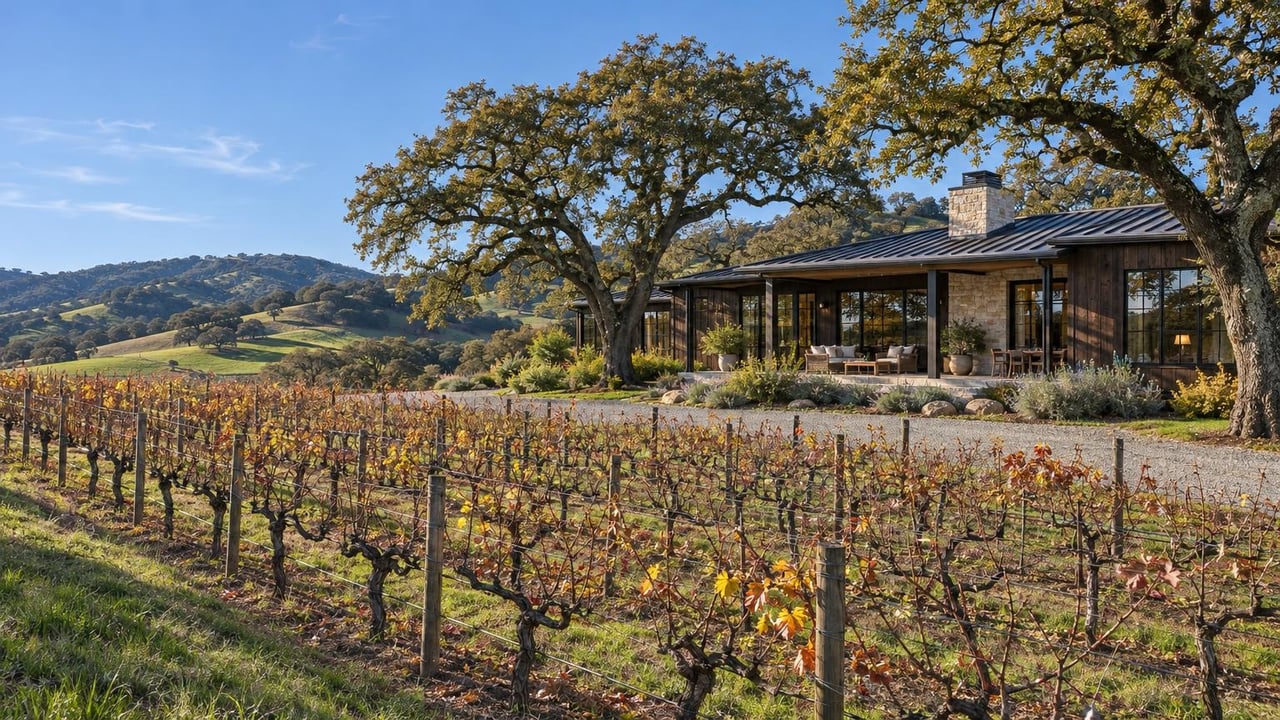
In November 2024, Benessere Vineyards came to market at $35 million. It is a 42-acre estate at 1010 Big Tree Road near St. Helena, with nearly 30 acres of vines. In June 2026, an online auction closed with an apparent winning bid of $9 million. That came to $10.15 million once the auction house's fee was added, according to the Press Democrat. In between, the estate was pulled from the market, relisted in February 2025 at $28 million, and pulled again.
The gap reflects a change in how buyers value vines, and that change is now showing up in Napa Valley and Sonoma County estate prices. For anyone in San Francisco considering a Wine Country second home with vines attached, that change matters more than any median price.
A Vineyard Is Priced Like a Business
The clearest account of the shift comes from Terrain's "Tangled Vines" report, published June 15, 2026, by the research arm tied to American AgCredit, a major agricultural lender. The starting point is plain: a vineyard is valued mainly on the income it can produce, from grape sales or from the wine made with them.
That income has shrunk. Terrain reports that California wine sales have fallen for four straight years and sit roughly 20% below their pre-pandemic level. California wineries used 2.6 million tons of grapes in 2025, against an average of 4 million tons a year from 2012 to 2019. The report also estimates that as much as 20% of the crop stayed on the vine in each of the past two years because no buyer wanted it. Wineries can buy surplus fruit cheaply on the open market, so they have less reason to pay for vineyards outright.
The fall numbers have not changed that. At a November 10 industry symposium, Turrentine Brokerage put Napa bulk wine at $12 a gallon, down from $16.25 a year earlier, and Sonoma at $7, as reported by MyAgLife. Spot grape prices rose somewhat after this year's harvest, but not by enough to signal a recovery.
The detail that matters most for a lifestyle buyer is Terrain's description of how lifestyle purchasers see vines. In the report's words, they "are often viewing the vines on lifestyle properties as expensive landscaping and attributing little value to them." Terrain calls investment buyers the most visible group in the market today, and they focus on premier Napa and Sonoma properties that can promise income for several years through solid grape contracts or seller leasebacks.
Taken together, those two observations explain Benessere. A seller whose asking price counts the vines as a productive asset is waiting for a buyer who is willing to pay for them. More and more often, that buyer only pays for vines that come with a buyer for the fruit.
One Appellation, Three Price Floors
Terrain describes three markets inside the same appellations, and each has a different floor.
At the top are the upper-tier properties in Rutherford, Oakville and the Russian River Valley that have reliable income or would attract a well-funded winery. Terrain's appraisers estimated that high-end properties in prime Napa were at least 10% below their peak as of May 2026, with "cracks" starting to appear. They expect any further decline in this tier to be modest.
At the bottom are marginal sites and older vines in secondary areas, which have lost as much as 50% of their peak value. Terrain argues these properties cannot fall much further, because buyers already give the vines almost no value. The floor is the value of open land minus the cost of pulling the vines out.
The middle is where Terrain sees "the potential exists for a more substantial erosion in value." These are estates too good to be priced as bare land and not good enough to draw an investor's contract-backed bid. Many Wine Country lifestyle properties sit in this tier: a well-kept house, a few acres of vines, and fruit sold year to year if it sells at all.
Activity was thin in the spring. Terrain counted 131 active vineyard listings across California as of May 2026, with Sonoma Prime among the heaviest segments. Only 19 vineyards had sold statewide through mid-May, with eight more pending, and average time on market was approaching 400 days. Terrain's appraisal figures date from May, which is the latest estimate available, and the transactions since then fit the direction it described.
What Has Traded, and Who Can Finance It
Terrain listed reasons to expect values to soften further in the near term, among them sellers who have gone unsold through long marketing periods beginning to lower their asking prices. Benessere's route from $35 million to an auction is one version of that. Two other recent transactions give a sense of the range. Kenwood Vineyards' nearly 33-acre Sonoma Valley winery property sold for $4 million on March 26 to an LLC led by Korbel owner Gary Heck, per the Press Democrat. In Calistoga, the Fairwinds Estate Winery property transferred to Calistoga Farms LLC on a deed recorded August 25 that implies a price of about $12.84 million, the Register reported.
Lending affects buyers as well as owners. Terrain reports that fewer lenders will finance vineyard purchases, that those still lending have tightened their standards, and that vineyard loans now carry a higher risk premium. When fewer buyers can borrow, more of the market is left to buyers who pay cash, and a cash buyer looking at an uncontracted vineyard has every reason to wait.
Reading This Fall's Listings Through the Contract
The estates on the market this fall can be read the same way.
In November, a 755-acre ranch in Sonoma's Rockpile AVA came to market at $9.5 million. It has two homes and 58 acres of vines, and the Press Democrat described the fruit as producing yearly income. Under Terrain's framework, the most important line in that listing is the one about income.
In October, Healdsburg's 52-acre Flax Estate and Vineyard listed for $22 million, with three residences and Pinot Noir vines in Russian River country, according to the Press Democrat. In August, a rebuilt Atlas Peak winery estate in Napa listed for $14.95 million with a main house, a guesthouse, a winery and 24.5 acres of vines.
Each of these sits at a different point between the top tier and the middle. The asking price shows what the seller hopes the vines are worth. A contract shows what someone else has already agreed to pay for the fruit. In this market, buyers are pricing the contract.
For a buyer touring estates this winter, a few facts separate one tier from the next. Is the fruit under contract, with whom, and for how many more vintages? Would the seller agree to a leaseback? How old are the vines, given that Terrain notes young vines appeal to buyers because replanting is so expensive? If the fruit has been sold year to year, a buyer is wise to price the vines at close to nothing and decide whether the house and land justify the number on their own.
Questions Buyers Are Asking This Season
Has the vineyard market reached its bottom? Terrain's June report called further softening in the near term "fairly certain." Its base case has the grape market starting to stabilize in 2027 or 2028 in most regions, with vineyard values reaching their low point not long after. The November Turrentine figures on bulk wine and spot prices do not yet point to a turn.
Does the slump reach Wine Country homes without vines? Less directly. In March, Napa County recorded 96 home sales, up 31.5% from a year earlier, while the median price fell 8.9% to $760,505 and average time on market rose to 98 days from 62, the Napa Valley Register reported. Healdsburg moved the other way. Its median rose 9% to $1.33 million across 45 sales in the second quarter of 2026, and a penthouse there sold for $7.8 million in June, which the Press Democrat called Sonoma County's highest condo sale at the time. Homes priced as places to live are following their own markets. The steepest repricing is in estates where the vines were part of the asking price.
Who is buying estates with vines right now? Terrain describes investment buyers chasing contracted income in prime appellations, wineries paying well only for adjacent parcels or vineyards with a reputation for designated wines, and comparatively few lifestyle buyers. A lifestyle buyer willing to act now meets relatively few others shopping for the same reasons, particularly in the middle tier.
If you are weighing a Napa or Sonoma estate this season, or deciding when to bring one to market, BrokerLuxe can review the property the way today's buyers will, starting with the vines and the contract behind them. Schedule a private consultation with Bryant Kowalczyk through our Wine Country practice.